

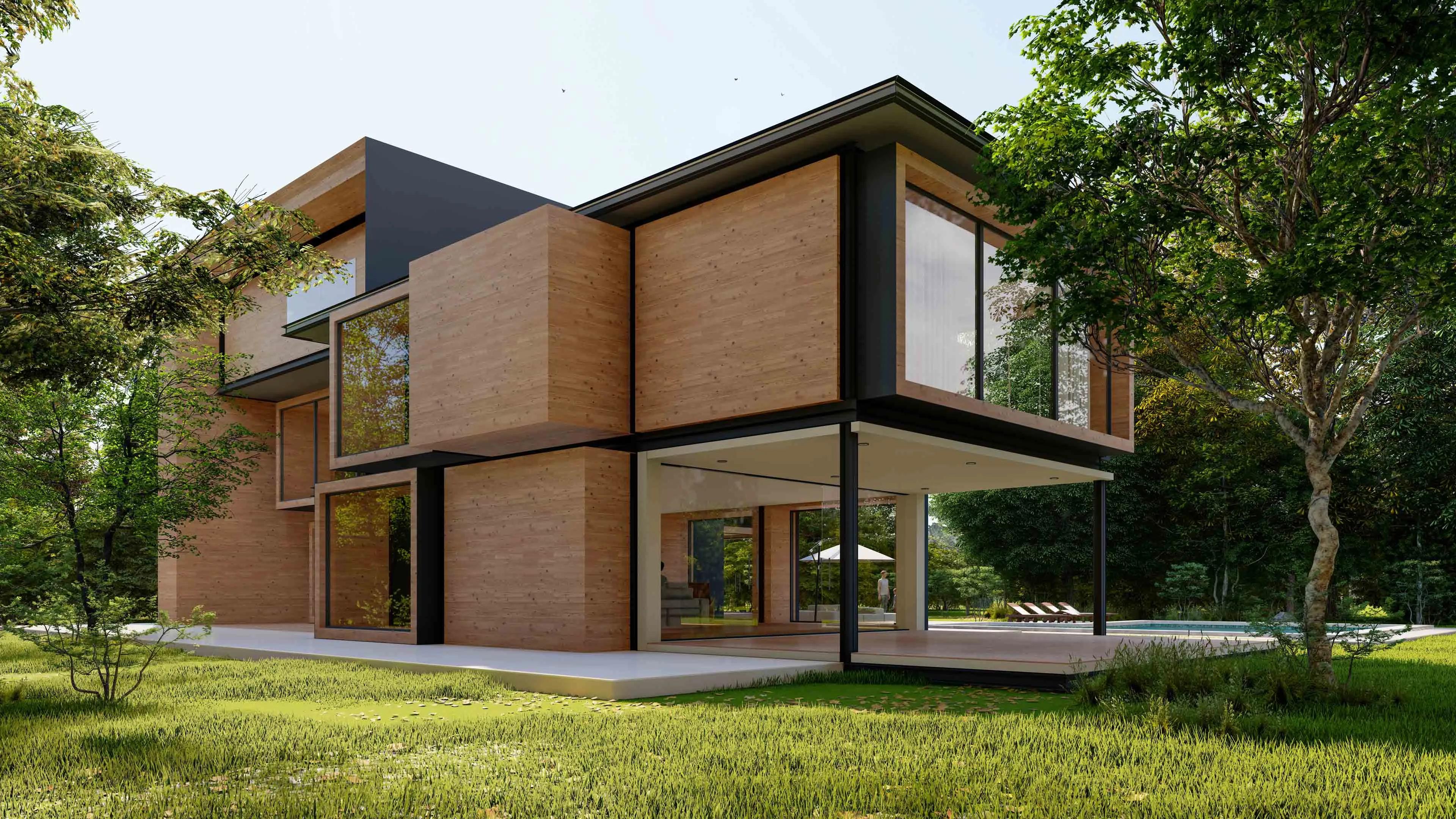
Throughout the year, buildings are exposed to the sun, rain, wind, and temperature variations. These aspects worsen surfaces and reduce structural appearance with time. The choice of the right exterior panel becomes critical to the long-term performance. Exterior wooden wall cladding in a modern building must be strong and offer protection and beauty. Century Exteria Panels are designed to address these combined needs with organised surface strength.
Weather protection is no longer a straightforward coverage. It has now added resistance, stability and seasonal reliability of the surface. Here, one can observe that a high-performance exterior panel can be used to make a difference in building life.
Moisture and Rain Exposure Protection:
Rain is also one of the most devastating weather conditions to the exterior of buildings. The continuous presence of moisture can lead to swelling, corrosion of the surface, and fungal growth. Traditional materials are prone to failure in the wet long-term conditions.
Century Exteria Panels are made to be a stable exterior panel even in high moisture conditions. Their structure limits the absorption of water and enhances dimensional stability. This reduces the possibility of surface warping or uneven expansion. Being exterior wooden wall cladding, they offer a protective outer layer that does not expose the building core to repeated rain.
Moisture resistance improves long-term structural reliability.
Resistance To Sunlight and Surface Fading:
Bright sunlight gradually wears out exterior surfaces and causes colour to fade. Prolonged exposure to ultraviolet can reduce the surface clarity and influence aesthetic consistency. This is a visible problem in commercial and residential projects.
Century Exteria Panels do not lose their surface integrity even under constant sunlight. All exterior panels are designed to withstand extreme climatic changes without rapid surface decay. As exterior wooden wall cladding, these panels retain visual acuity across seasons. This stability allows the facades to retain their desired appearance without the necessity to replace them frequently or perform remedial maintenance.
Sun resistance directly supports long-term visual performance.
Temperature Fluctuations Stability of Structure:
The exterior materials expand and contract with the day and night temperature variations. The thermal movement is repeated, and this weakens the traditional cladding systems with time. Fissures, discontinuities, and surface dislocations may take place.
Century Exteria Panels are made to minimise dimensional instability under thermal stress. A well-designed exterior panel responds to heat variations without compromising alignment. The panels are applied as exterior wooden wall cladding, and in climates with extreme seasonal variation, the panels maintain the uniformity of the surface. This homogeneity renders facades secure and aesthetically structured.
Temperature resilience helps in reliable performance.
Improved Wind Resistance and Surface Strength:
High wind pressure can loosen poorly installed or weak cladding systems. Lightweight materials may drop or shift in the case of strong winds. Structural fastening and panel strength are important in such conditions.
Century Exteria Panels are constructed as a robust exterior panel system capable of withstanding environmental pressure. Their design enables rigidity at the surface and stable installation. When used as exterior wooden wall cladding, they provide reinforced coverage over elevations. This additional strength helps to reduce vulnerability during storms or high wind exposure.
Wind resistance supports structural confidence.
Long-Term Surface Performance With Minimal Maintenance:
Weather protection also depends on the ease of maintenance of surfaces. Lifecycle costs are increased by materials that need regular sealing or repair. Property owners would prefer to have systems that are stable and whose maintenance can be managed.
Century Exteria Panels are also dependable in terms of functionality, as it is an advanced exterior panel system that requires structured but simple maintenance. They are not easily affected by the environment, and their surface does not deteriorate easily. As exterior wooden wall cladding, they are transparent and do not go through lengthy treatment processes. It is a predictable maintenance profile that improves long-term usability of residential and commercial buildings.
Maintenance is minimal, which contributes to operational efficiency.
Plasticity in Modern Exterior Applications:
The modern architectural designs demand durable and controlled facades. The materials must be technically efficient and address the contemporary aesthetic requirements. Performance is no longer sufficient.
Century Exteria Panels are a trusted exterior panel and offer a refined surface display. When selected as exterior wooden wall cladding, they can be used with organised architectural forms and modular exterior designs. Their flexibility allows designers to maintain aesthetic intent without sacrificing weather resistance. This balance enhances performance and facade identity.
Design flexibility complements environmental protection.
A Reliable Solution to Weather-Resilient Architecture:
The secret of weather protection is the wise selection of materials and the frequency of structural integrity. At the same time, the surfaces must be resistant to moisture, sunlight, temperature change, and wind pressure. A high-quality exterior panel supports this built-in defence.
Century Exteria Panels offer good protection as exterior wooden wall cladding in most climates. Their stability is designed to increase the durability of the buildings without compromising the visual refinement. CenturyPly offers a solution that balances the structured design with the practical weather resistance in projects that need long-term reliability of the facade.